

Join Vancouver Lawn Bowling Club *
Join Vancouver Lawn Bowling Club *
Benefits of joining
Lawn bowling is a fun, welcoming sport for all ages, from young teens to lifelong players. Whether you’re here for relaxed social games or competitive play at the club, you’ll find your place on the green—and probably make a few friends too.
What is included
Coaching lessons for new bowlers.
Use of club’s bowls, varying sizes and weights.
Access to the clubhouse and grounds.
Unlimited bowling privileges on playing days and evenings.
All social events & club hosted tournaments.
At the VLBC we draw for teams during regular play, making sure that the opposing teams have complementary levels of experience. This way you get to play with and against most of the other members during the season.
Check the calendar to know when you can bowl, social events, tournaments or if the greens are closed for maintenance.
Club Fees 2026
-
Full $ 210
First Time $105
Second Club (Proof of primary club required) $120
Social $50
Trial Member* (New Members, One Month) $50
*Enjoy a month trial period to try out playing lawn bowling. Your trial fee will be deducted from your annual membership if you upgrade to a full membership. Only one trial month allowed per person.
-
Full $84
First Time $42
Second Club (Proof of primary club required) $60
Trial Member* (New Members, One Month) $16
*Enjoy a month trial period to try out playing lawn bowling. Your trial fee will be deducted from your annual membership if you upgrade to a full membership. Only one trial month allowed per person.
-
Groups of 1 - 8 players do not need advance booking.
Adults $15
Youth $7
Affiliate Bowling Club Member $10
Groups of 9 - 20 players MUST pre-book.
Adults $25
Youth $7
Affiliate Bowling Club Member $10
Group Drop-Ins are available only on days when members are bowling (see hours of operation below). One lane will be set up, and coaching and club bowls can be provided. No use of clubhouse for entertainment purposes.
-
Club rentals require a minimum of 20 players and MUST be booked in advance. Please see the rental section for full details and the calendar for date and time availability.
Adults $40
Youth $40
Memberships & Drop-In Fees can be paid by Cash, Cheque, E-Transfer or Credit Card.
Please send your e-transfer to: ngvancouver@yahoo.com. The account is set up for automatic deposit — no password is required.
Operating hours
Club house hours of operations – May to October, 2026
1:15 pm Start – Weekends & Mondays afternoons
10:15 am Start – Wednesday mornings
6:45 pm Start – Tuesday & Thursday evenings (with advanced notice)
Drop-ins are welcome The drop-in fee of $15 includes the use of club bowls.
Please wear clean, flat-soled shoes.
Lawn Bowling
Lawn bowls is a strategic target game that is very similar to curling. Lawn bowling is a sport with many traditions. There are a few rules, a number of conventions, and a reliance on fair play that depends on the honour system. Often played outdoors, its low impact nature makes it extremely accessible for Canadians of all ages and abilities. The sport is played by more than 14,000 registered local bowlers across Canada in over 200 clubs from coast to coast. Lawn bowls also offers international competition opportunities such as the Commonwealth Games and World Championships for able-bodied and para-bowlers. Lawn bowls is a natural fit for healthy, active life strategies as it provides physical, cognitive, emotional and social benefits to all participants.
Overview
The number of players on a team can be from 1-4. A Skip is designated as the captain, who plays last.
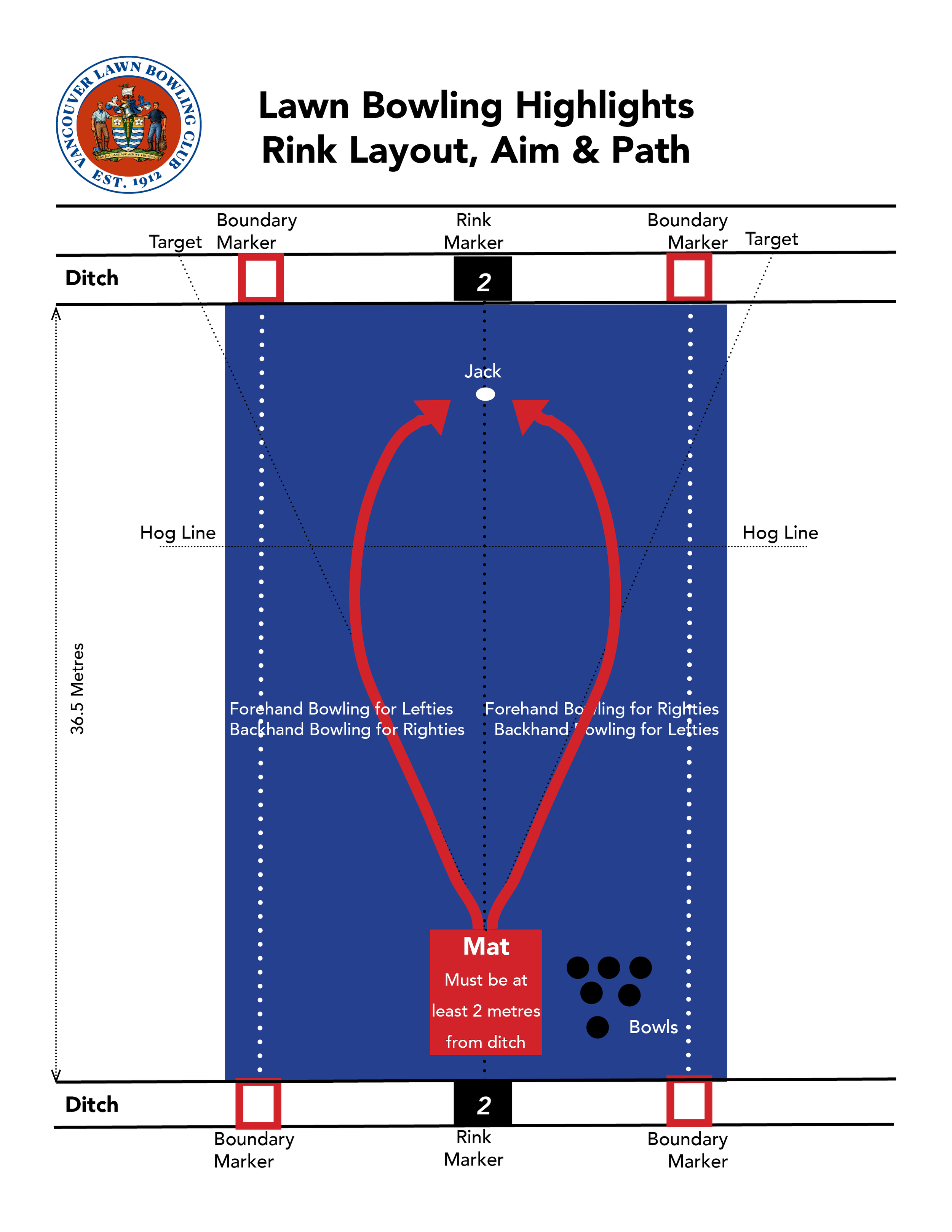
Each bowling lane is 36.5 metres. The lead bowler places the least 2 metres from the ditch behind them. Boundary markers are visible on the left and right of the lane and the lane marker/number in the centre.
The Bowling Head
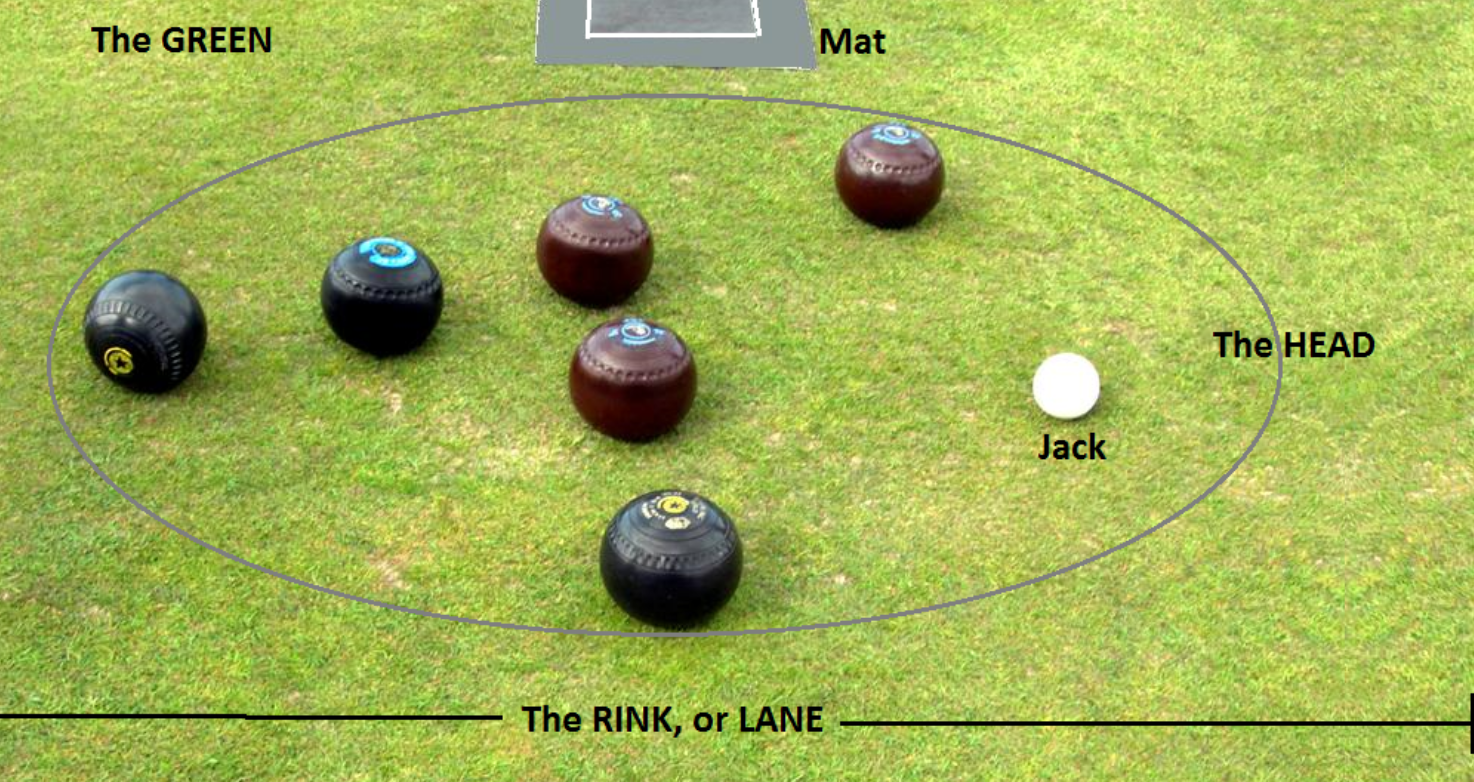
Playing from the mat (dark grey in the picture), the team Lead places the white target, called a Jack, by rolling it toward the Skip at the other end of the rink, or lane. At the start, the Jack is moved by the Skip, directed by the Lead, to centre it in the lane.
Once the Jack is placed, that Lead rolls (not throws) the first bowl, trying to place it as closely as possible to the Jack. The next bowl is rolled by the Lead from the other team. Next, the first Lead plays their second bowl. This continues, with alternating team players rolling each of their bowls until the Skips have delivered all their bowls. That completes the End, and a score is determined.
The closest bowl to the Jack is 1 point. If the same team has more of their bowls next closest to the Jack, each one counts 1 point. For instance, in the picture above, if we assume the 3 brown bowls are from the same team, the score would be 3 points for Brown. Scoring proceeds until the other team’s bowl is determined to be next. So, for an End, a team may have 1, 2, or more points. That score is placed on the scoreboard.
The bowls are then raked up and a mat is placed in the centre of the lane at the, now, opposite side. The team winning the last point goes first, rolling the Jack down the lane for centring by the Skip.
Play generally proceeds for 10 ends, in friendly club play. This takes about 1-1/2 to 2 hours. The number of ends can be agreed to be a different number for special occasions. Competitive play may have 16 or 20 ends.
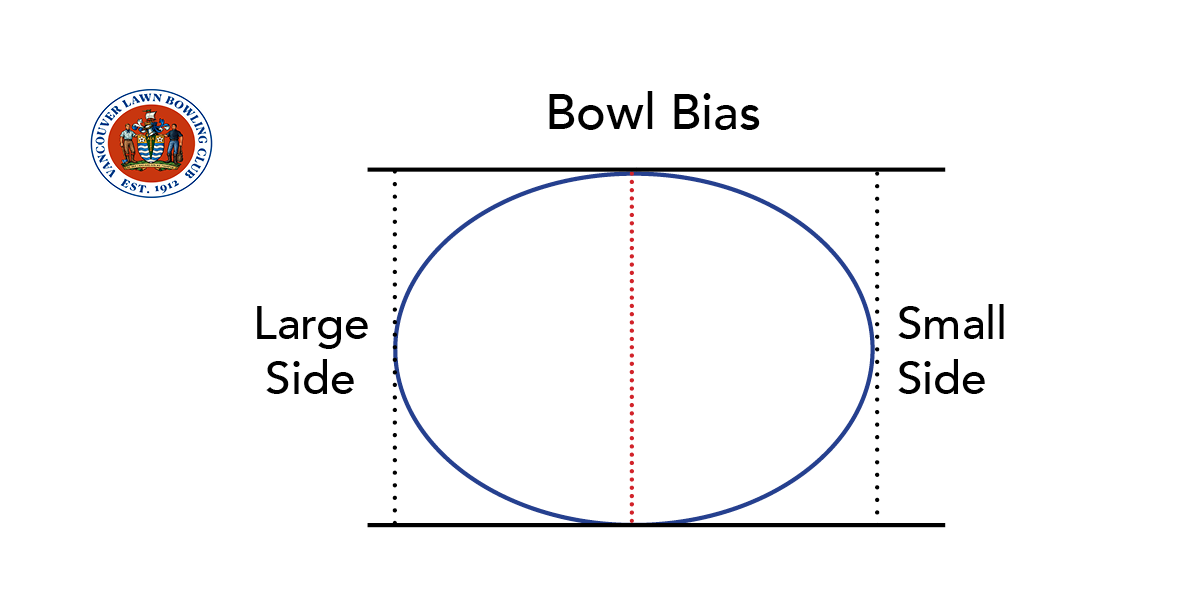
Lawn Bowl Bias
Lawn bowls have a bias on one side of the bowl. The bias is the sole reason for the bowl bending on its journey up the green. There is no technique used by the bowler to make this turning action happen.
It is a common misconception to assume the bowl has a weight embedded within the bowl – this is incorrect. The bias of a bowl is achieved through shaping one side, so that it is not perfectly round. The shape achieved by the manufacturer will provide a certain amount of turn.
Modern bowl manufactures can also impact many other aspects of the bowls trajectory, including when the bowl starts to turn and how much it turns as it begins to slow, all of which is determined by the design of the bias of the bowl.
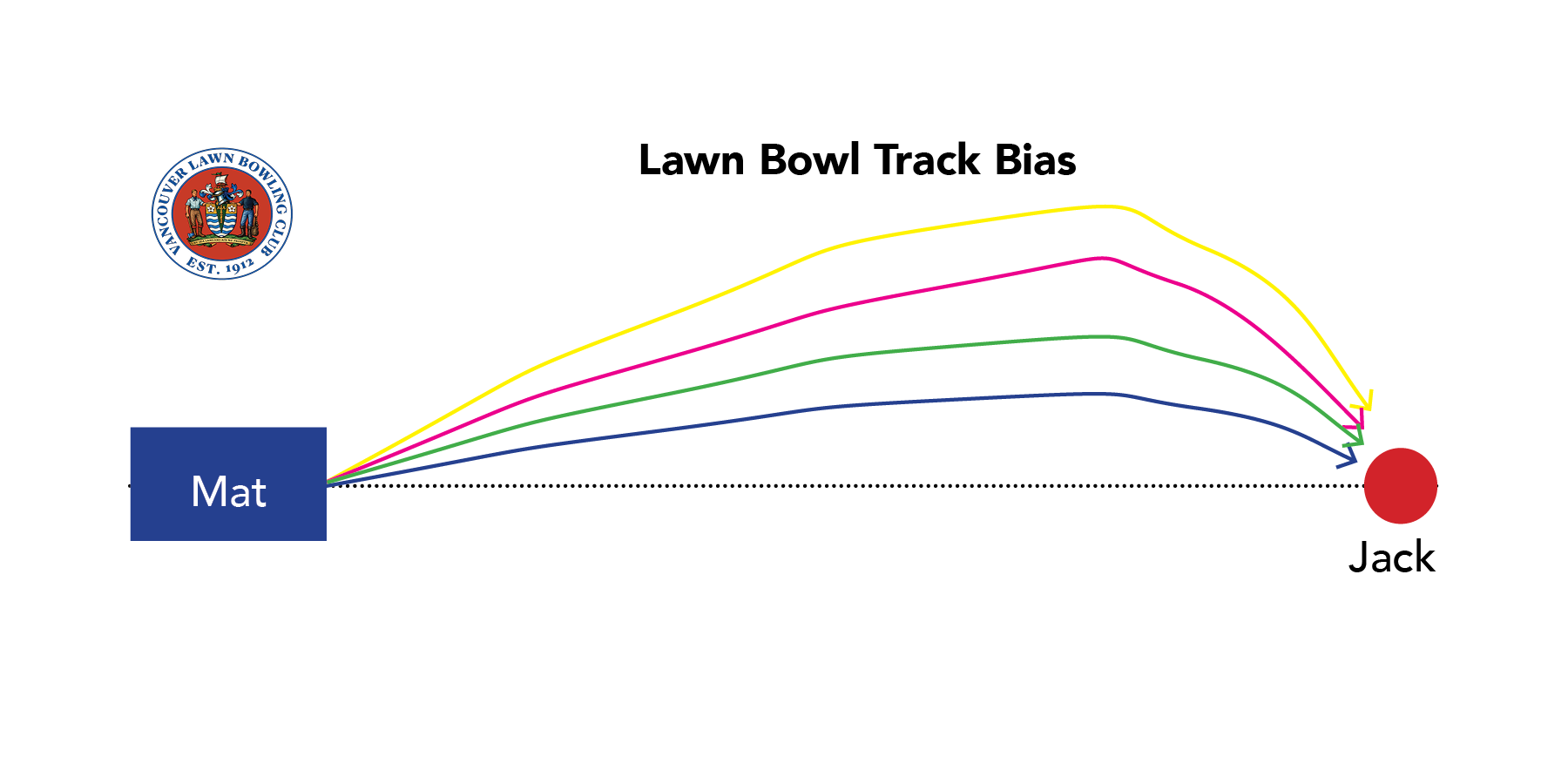
Lawn Bowl Track Bias
In the image above we see that a bowl will take a certain trajectory, rather than being able to go straight. This is because bowls are made with one side actually smaller than the other side. A bowl will, therefore, always turn toward the “small” side – see the lower drawing. This side is identified on each bowl by a smaller circle imprinted on that side.